The questions asked before the first Giallo Siena marble order
The eight questions that come up first when Giallo Siena marble is specified. The care and maintenance page answers the one that comes up after the order.
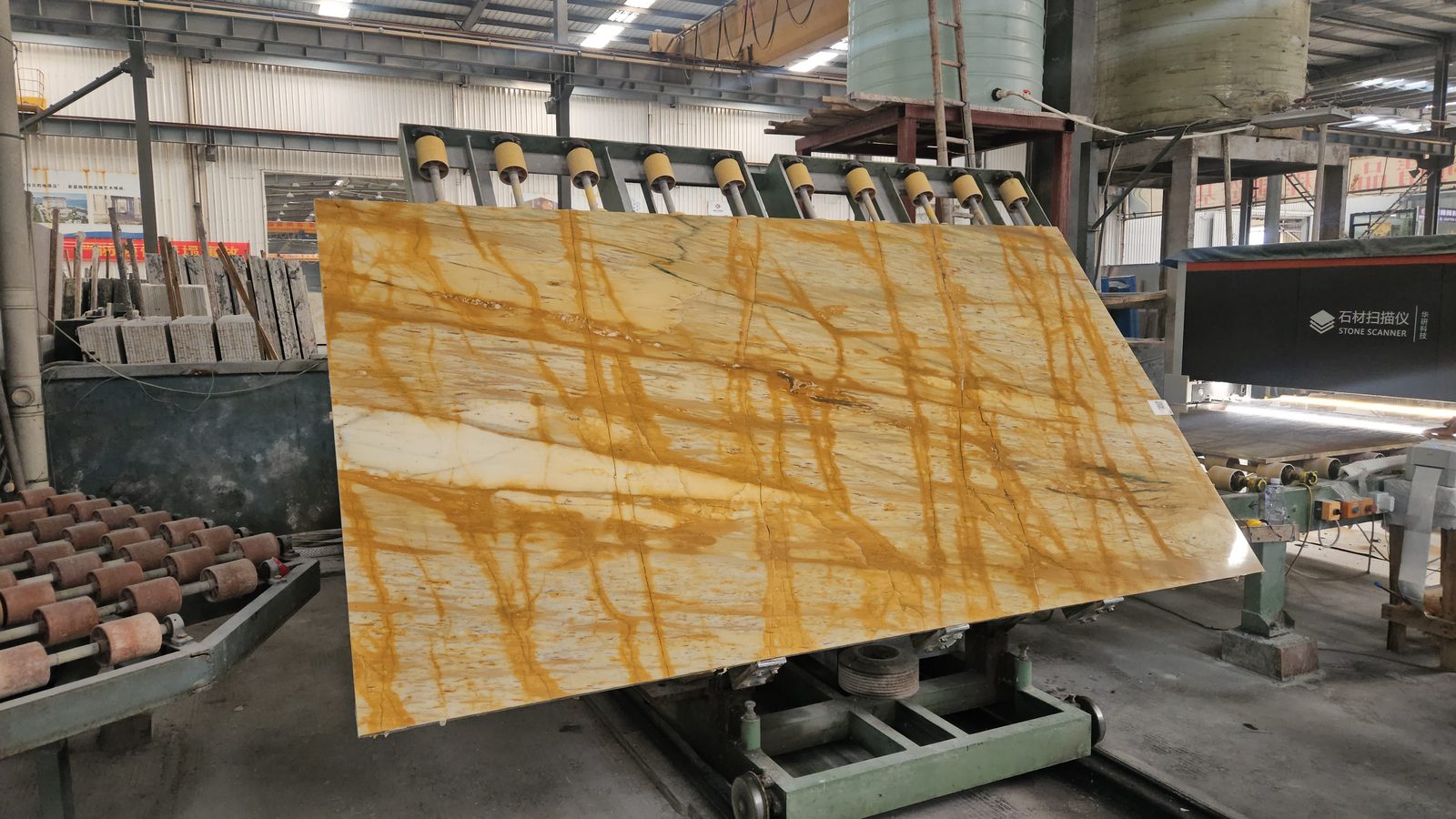
Where is Giallo Siena quarried?
Sovicille, in the province of Siena, Tuscany. The stone formed in the Jurassic as calcareous sediment, later altered by pressure and heat into the compact marble it is today.
What is its water absorption?
0.12% by EN 13755-08, published in the technical sheet for the material. That figure is low, so sealing is routine rather than remedial.
What thicknesses are available?
18, 20 and 30 mm are the thicknesses most commonly supplied commercially. After vacuum resin treatment, slabs can be cut as thin as 10 mm.
Can it take a flamed finish?
No. Flaming is a granite process, and this is a marble; flame does not appear in the published finishing list for this lithotype. A supplier offering a flamed Giallo Siena is offering a different material.
How is the price set?
By purchasing scale. We buy across many orders rather than one, so the acquisition price works, and the acquisition price is what makes the supply price work.
What else is this stone called?
Giallo Siena is also written Giallo di Siena, Giallo Siena Unito, Siena Gold, Golden Siena, Siena Giallo, Siena Yellow, Amarillo Siena and Giallo Sienna. The international reference is ICITMA00793. Any of those names on an order means the same stone.
Will the wall and the floor come from the same stone?
They will come from the same material, but not from the same slab unless they are booked from one. Slab grouping is a decision rather than an afterthought: the slabs are selected so the figure runs the way the drawing needs it, and the batch is chosen so the yellow tone holds across the job.
How thin can it be cut?
A 10 mm minimum after vacuum resin treatment, which is what makes the 15, 18 and 20 mm commercial thicknesses possible on a stone that would otherwise be too fragile for them. The thicknesses held as standard stock are 15, 18 and 20 mm.
How is it shipped, and what do the trade terms mean?
Slabs travel on edge in a banded bundle, never flat, with the polished faces separated so they cannot rub. Dispatch is from the processing base in the Shunde and Yunfu cluster, and the loading port is chosen against the shipping line. Terms are quoted as FOB, CIF or delivered, according to the job.
How long does a sample take, and what does it cost?
The cost of cutting the piece and the carriage are quoted against the request, and the sample is not charged for against an order. The piece is cut from the stock that would be supplied, so what arrives is the material rather than a photograph of it. The date it can leave comes back with the quote.
Is natural stone safe to cut?
It carries the same duty as any stone: crystalline silica. Cutting, grinding, drilling and dry sweeping release respirable dust, so the work is done with water or with extraction on and the area ventilated. The safety data sheet travels with the order, and a Proposition 65 warning applies to sales into California.
Do you install it?
Yes. Design, sourcing, production, quality control, export, freight, installation abroad and the labour on site are held in one chain rather than handed down through intermediaries. A project that needs the whole chain is one order and one point of contact.
What do you need from me before you can quote?
Four things: the material, the size, the finish and the destination. A stone enquiry is an agreement about those four, and the answer depends on them. Drawings or a cut list are better than a description, and a sample in the hand beats both.
Do you sell slabs directly to the public?
We take enquiries for trade and project supply and answer with what can actually be shipped. There is no online checkout, because the material, the size and the destination have to be agreed together.