What is the best finish for Giallo Siena marble?
Polished for a wall or a reception desk, honed for a floor.
Finishes · Read the full answer
A finish is not a preference, it is a decision with consequences: what the surface takes, how it wears, and how it behaves when it is wet. Each one below carries a verdict - whether it is a standard order on this stone, whether it depends on the block, or whether it is not available here at all. The edge profiles we cut are drawn to section against the thickness of the material, and what to do to each finish once it is down is on the care and maintenance page.
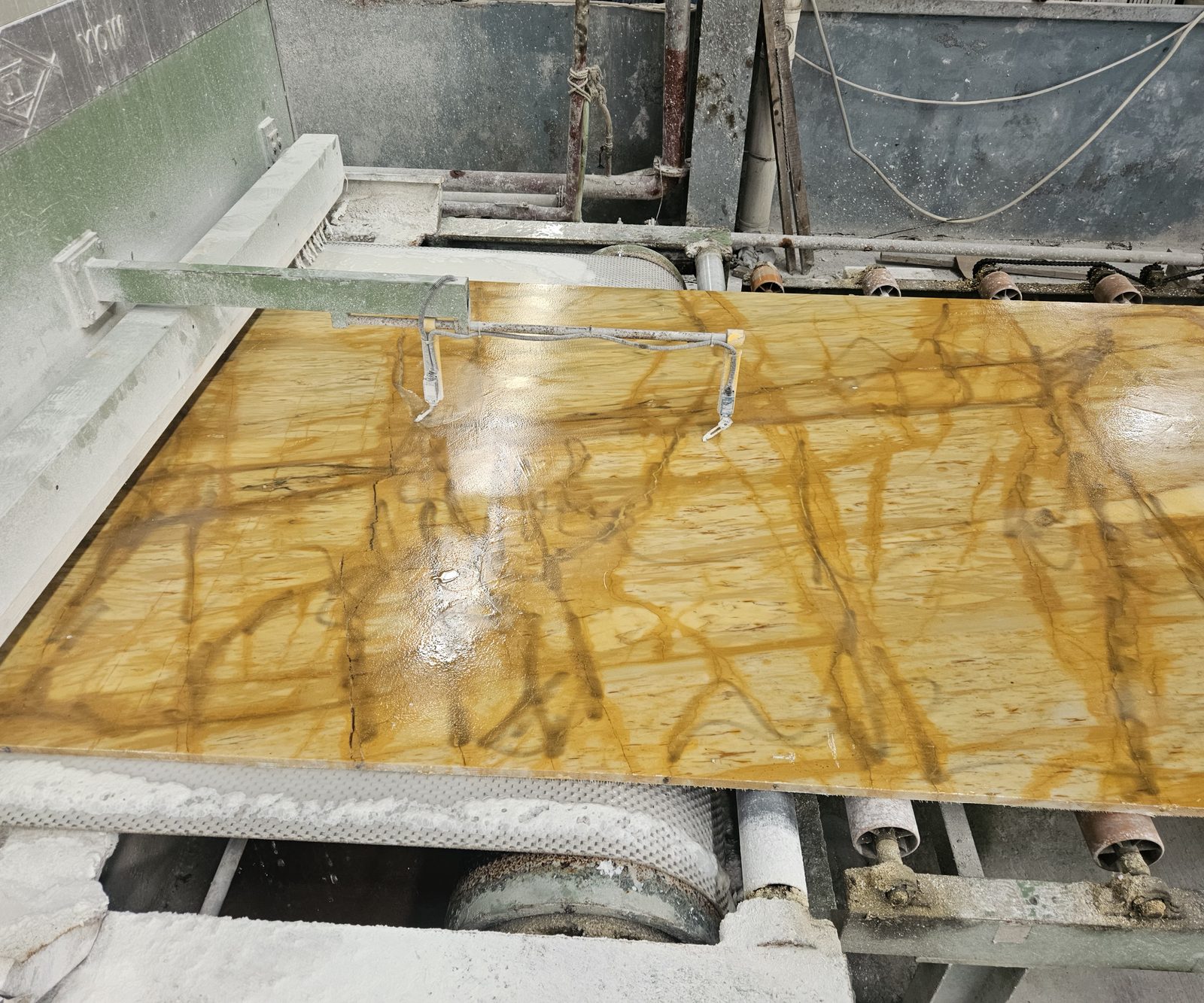
A mirror surface. The golden ground reads deeper and the veining gains contrast; reflections of a lit room are the strongest on this stone.
Feature walls, lobby floors, reception desks, formal bathroom walls — anywhere the stone is meant to be looked at rather than walked on.
Soft sheen. The colour reads truer than polished and the texture stays quiet, which is why it suits large floors where gloss would be busy.
Flooring, worktops, stair treads, bathroom floors — the surfaces that are used rather than admired.
A muted sheen with a tactile grain. It reads as a matte stone with depth rather than a flat one.
Feature walls and furniture where the texture should be felt as well as seen.
A low, directional texture. Unpolished, uncoated, and completely honest about being raw stone.
Wall cladding, paving, and any application where a further finish would be wasteful.
A rugged, cleft surface with the stone's own bedding visible.
Feature walls, retaining and landscaping work, and the kind of project that wants the raw bed of the stone left visible.
A fine directional scratch pattern with a satin sheen.
Vertical surfaces and furniture where a brushed grain suits the design language.
A rugged, pitted surface with real relief. The veins resist the acid and stand proud.
Feature walls and rustic worktops.
A softened, aged surface where the raised areas are worn back and the veins read darker.
Period and classical interiors, and worktops where a lived-in look is wanted.
A uniform stippled texture with a matte, sandy hand.
Commercial and civic wall cladding, and traditional external paving.
A coarse, hand-worked relief with visible tool marks.
Historic restoration, and feature work where the hand is meant to be visible.
A linear relief that catches light in bands and throws a shadow line along each groove.
Feature walls and vertical cladding, where the groove width and depth are chosen to match the panel module.
Worn edges and a softly weathered surface — the look of stone that has been in a building for a century.
Floor and wall tiles in rustic or reclaimed schemes.
A gentle, rippled surface — the traditional finish of Italian stone stair treads.
Stair treads and external steps, where the rounded surface is walked on for generations.
A regular diaper pattern of raised squares with a fine grout-like shadow between them.
Historic and civic work, and as a companion to mushroom on stairs.
A fine, even, matte texture across the whole face.
Exterior paving and wall panels, and non-slip stair nosings.
Sharp, accurate edges and complex profiles, including inlays and lettering.
Custom profiles, inlay work, lettering, and complex cut-outs.
A gritty, matte surface with a slight tooth.
Rough-textured paving and utilitarian applications.
Polished for a wall or a reception desk, honed for a floor.
Finishes · Read the full answer
No.
Finishes · Read the full answer
43 USRV dry and 16 USRV wet on the honed surface, published to EN 14231-04.
Slip resistance · Read the full answer
Polishing takes the honed surface the next step further, to a full gloss.
Finishes · Read the full answer
Several, and each of them depends on the piece rather than on the stone.
Finishes · Read the full answer
The finish by name, the edge by profile, and the maintenance regime that goes with them.
Writing the specification · Read the full answer