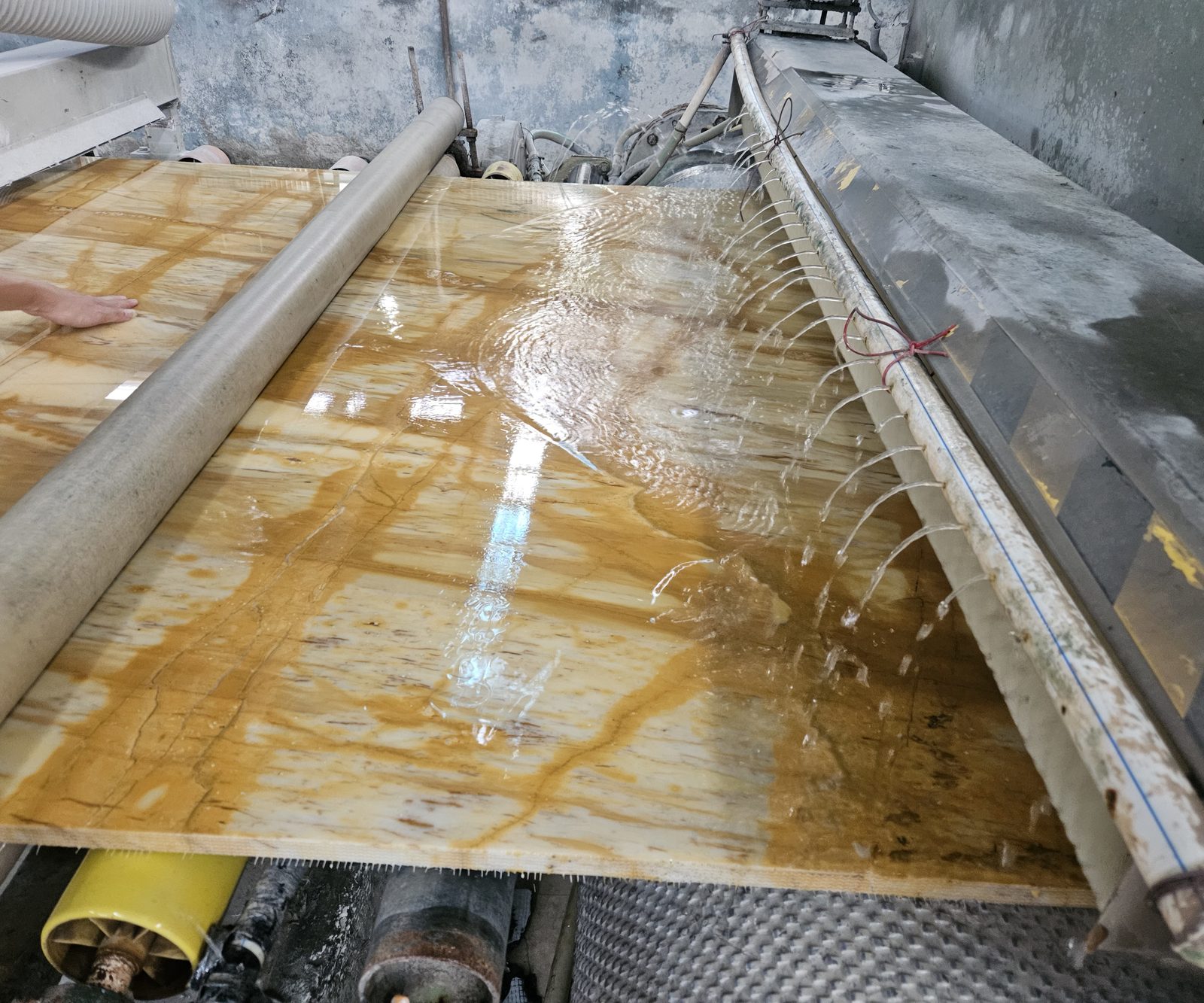
Slab
A rectangular piece of stone cut from a block and normally sold by area rather than by piece. The thickness of a slab is the thickness of the stone, and its length and width are set by the block it came out of.
Slab — the sizes we holdThe words that come up in a stone order, in the words a buyer would use them. Each one links to the page that carries the fact.
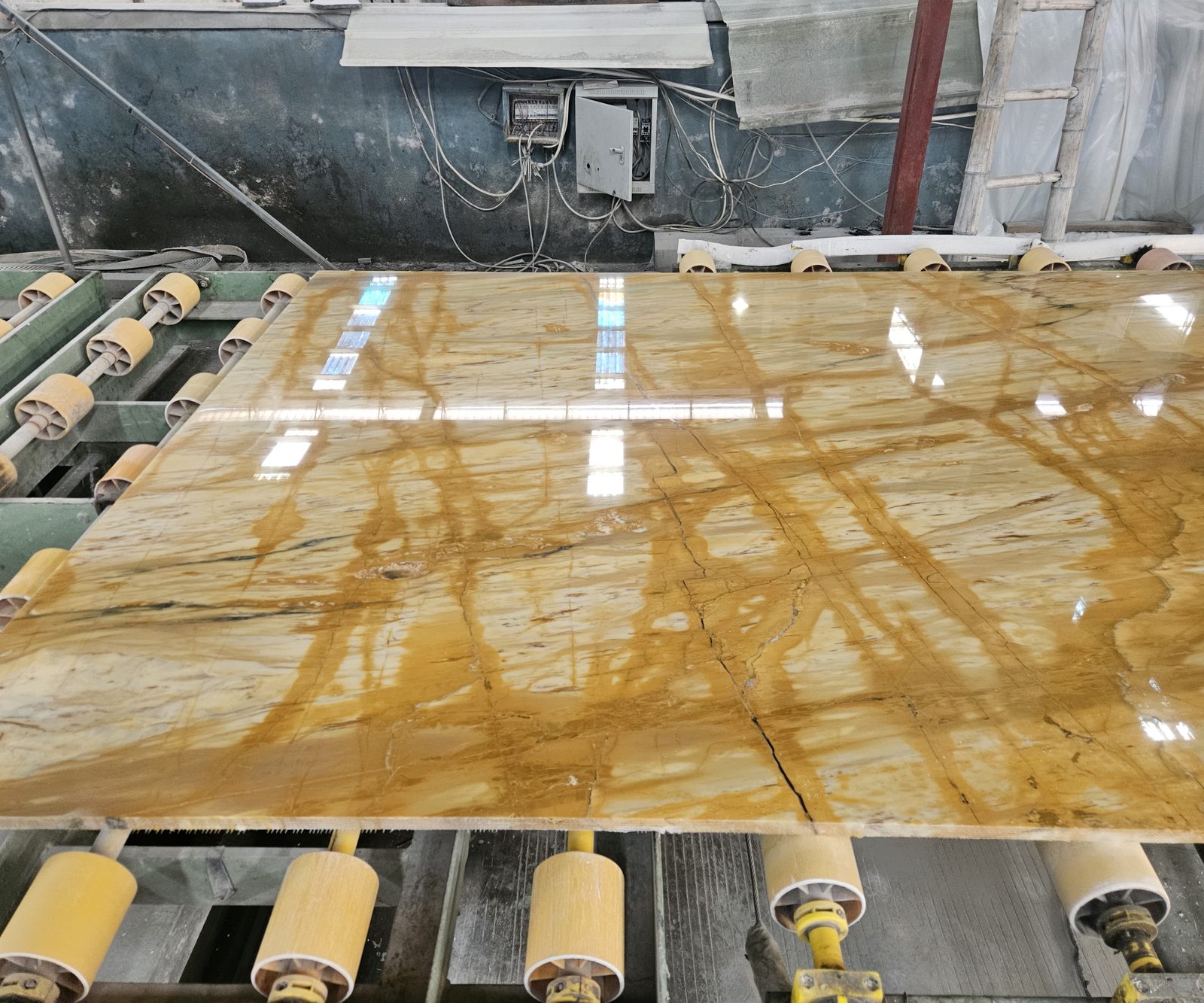
29 of 29 terms shown
A rectangular piece of stone cut from a block and normally sold by area rather than by piece. The thickness of a slab is the thickness of the stone, and its length and width are set by the block it came out of.
Slab — the sizes we holdThe rough piece quarried out of the hill, before any sawing. It is what a slab is cut from, and it is the constraint on the size of every slab that comes off it.
Block — how the stone arrivesLaying consecutive slabs out so the figure mirrors across the joint, the way the pages of a closed book face each other. It is what makes a floor read as one surface rather than as a series of panels.
Bookmatching — how a pair is cutStronger than bookmatching: the slabs are cut and sequenced so the movement of the stone runs continuously across the whole job rather than turning at each joint.
Vein-matched — how a run is cutGrinding a slab to a stated thickness. The slab you are given measures a millimetre or so under the nominal figure, because calibration takes material off. This is normal and it is why a weighed slab reads light.
Calibration — why a slab reads lightA satin finish: the surface is cut with abrasive grit and left matt, with no reflection. It takes the glare off a floor and it is the surface to ask for where the floor gets wet.
Honed — the satin finishA full gloss: the surface is progressively refined until it reflects. It shows the colour of the stone most strongly, and it shows every mark and every etching.
Polished — the full glossA finish made by heating the stone so that its surface crystals expand and fracture. It is a granite process, and this marble does not take it - a flamed Giallo Siena is a different material wearing the name.
Flamed — and why this stone cannot take itThe edge taken off by a small chamfer, two millimetres or so. It is the default for a worktop because there is no corner on it to chip.
Eased edge — drawn to sectionTwo pieces joined at forty-five degrees so that the edge reads as one solid thickness. It is how a thin material is made to look thick, and the join is the weak point.
Mitred edge — drawn to sectionApparent thickness built up from two or more pieces of thinner stone. It is how a twenty millimetre slab is made to read as a sixty millimetre one.
Laminated edge — drawn to sectionHow much friction a surface has when it is wet, measured on the USRV scale. For this stone the published figure is forty-three dry and sixteen wet, and the wet figure is the one that matters in a bathroom.
Slip resistance — the published figureHow much water the stone takes into its pores, as a percentage of its weight. This stone absorbs between zero point zero four and zero point one two per cent, so sealing is routine rather than remedial.
Water absorption — the published figureHow much bending the stone takes before it breaks, measured in megapascals. It is the figure that tells a fabricator whether a cantilevered piece needs support under it.
Flexural strength — the published figureHow much crushing load the stone takes, measured in megapascals. It is high for a marble, and it is one of the reasons a yellow stone can be used in a commercial floor.
Compressive strength — the published figureDescribing a stone made of fragments broken and re-cemented together. This one is: the white calcite lines running through it are the seams, and they are why the corners need care and the slabs are normally resin-backed.
Brecciated — how this stone is put togetherThe pattern of lines and figure running through the stone. On a yellow marble the veining is what carries the colour from one piece to the next, and it is why two blocks never match.
Veining — reading the figureThe material used to close the small holes and cracks in a slab before it is polished. A resin-backed slab is normal practice on a brecciated stone, and it is what lets a ten millimetre cut be taken from the block.
Fillers and resin — why it arrives resin-backedOne group of slabs cut from one block. Slabs from the same batch match each other; slabs from different batches do not, however close the colour looks on a screen.
Batch — how we group the slabsHow long between placing an order and the goods leaving. Material held in our own warehouse ships from stock; anything not held is cut to order.
Lead time — how long it takesWhat the stone is laid on, and what carries the load. On a floor the substrate is sized for the span between the supports, and on a bench or a worktop it is what stops the stone breaking in the middle.
Substrate — what carries the loadStone cut to the dimensions on a cut list rather than sold as a full slab. The dimension is confirmed against the block before the saw passes, because the block is the constraint and not the saw.
Cut to size — working from a drawingThe way the stone is turned on the slab before it is cut. On a brecciated marble it decides where a piece can be taken from and where it cannot.
Vein direction — which way the figure runsA penetrating treatment that slows the water going into the stone. It reduces absorption; it does not stop the stone reacting with acid and it does not protect it from being scratched.
Sealer — what sealing is forThe dull, lighter mark left when an acid takes the polish off the surface of the stone. It is not a stain and cleaning will not shift it - it has to be re-polished.
Etching — what a polished floor does to acidWhite powder on the surface, which is salt coming out of the slab rather than something sitting on it. It is brushed off and rinsed, and it is a question for the slab rather than for the finish.
Efflorescence — the white bloom after layingThe volume of open pores in the stone, as a percentage. It is how much liquid the stone will take, and it is the number that decides how quickly a stain goes in.
Porosity — how much liquid it takes inThe place the stone comes out of the ground. This stone is quarried in the Sovicille district of the province of Siena, in Tuscany, and the quarries are not ours.
Quarry — where the stone comes fromThe commercial quality band a stone is sold in, which for a natural material means how much of the figure it carries and how sound it is. A yellow marble is graded by its pattern, not only by its colour.
Grade — how the blocks are sorted